Originally designed by Bob Grimsdell the course was also remodelled by Golf Data without losing any of its unique features, and today offers a great golfing experience for all levels of players. The layout is well balanced with six holes favouring a draw, four a fade and the remainder, relatively straight shots.
Hole 1
A generous fairway flanked by mature trees beckons those who are able to drive the golf ball straight and long. From the left of the short grass, a safe option is to lay-up, as the green is tucked behind a willow surrounded pond and also guarded by water and bunkers to the right. However longer hitters who find the middle to right of the fairway may still be able to go for the flag in two.
Hole 2
This dogleg-left par 4 is approached from a tee-box set well below the level of the fairway, which is hidden from view by the upward slope as well as a hospital and trees to the left of the fairway. A good tee shot to the right hand curve of the dogleg opens up the hole, guarded on the right by a large bunker.
Hole 3
Provided the player is able to avoid the massive trees that tighten both sides of the opening to its fairway, all the potential trouble on this hole is to the right, including a variety of trees and a strategically placed shallow bunker. The large undulating green can bring a variety of tricky pin positions into play and approaches that stray left or beyond will find the player in a facing a challenging chip-shot to get up and down.
Hole 4
A large grove of massive blue-gum trees at the nearside corner this dogleg right layout should discourage all but the strongest players from trying to cut it too closely. However, a prudently placed tee shot is rewarded with a clear path to another large undulating green, guarded by two large bunkers on the right hand side and another at the front left.
Hole 5
Differently positioned tee-boxes allow for this par 3 to be approached from a roughly westerly or south-westerly direction, each bringing different bunkers, wind conditions, trees and grassy mounds and swales into play. Although the large, sloping green can accommodate some challenging pin positions, all but the most reckless of tee shots should allow the player to at least save par.
Hole 6
A narrow entrance to the fairway, with out-of-bounds on the left and water to the right, makes this a challenging par 5 requiring an accurate drive to find the ideal landing area. Approaching the green from there will usually demand a well-struck fairway wood or long iron, followed by a wedge to the wide, raised green which is well guarded by bunkers in front and to the right.
Hole 7
Certainly the most daunting, if not the most difficult par 3 at Randfontein, this hole was designed by Robbie Marshall of Golf Data as a tribute to the famous number 16 at Augusta. Played entirely over water from a variety of tee-boxes, its green begins at the edge of the dam and is protected by bunkers left, right and behind the putting surface.
Hole 8
A reasonably straightforward par 4, with obvious dangers presented by large trees on either side and a fairway bunker on the right, this hole requires an accurate drive, as straying from the fairway will cause serious problems. A water feature to the left, which also extends behind the hole, guards the strategically bunkered green.
Hole 9
While the fairway here is more than generous, errant tee shots will find water on the left and fairway bunkers to the right. An interesting challenge is created by a large tree in the centre of the fairway some 40 meters from the green, demanding an accurate approach shot to reach the putting surface in regulation. . Aiming for the greenside bunker may also seem a safe idea but will require some precision coming out, particularly when the hole is cut close to the edge of the dam.
Hole 10
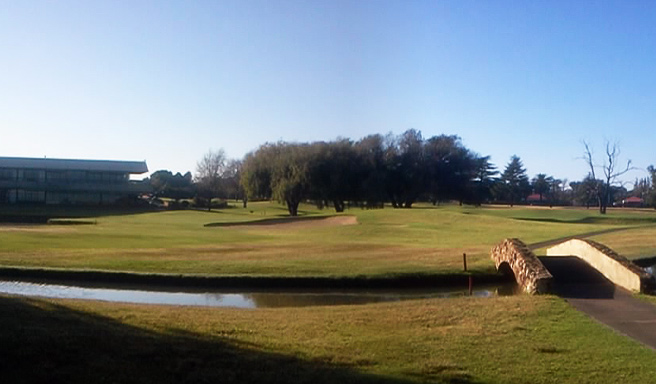
Featuring a subtle tribute to the famous bridge over the Swilcan Burn, this dogleg right short par 4 provides long hitters with an opportunity to go for the green. Dangers here can be found in the form of water to the right and the fact that if a tee shot runs through the fairway, trees aplenty will hinder a direct approach. Players who hit their club of choice over the willow tree to seek the middle of the fairway, will be left with a clear view of the green, which is well protected by two bunkers on the right and one on the left.
Hole 11
Another generous fairway makes this dogleg left par 5 a pleasure for those who don’t stray too far left or right. A well-struck fairway wood or long iron for stronger golfers makes the green quite accessible, although it is well guarded by four large bunkers, one of which has been cleverly placed some 50 meters in front of the green.
Hole 12
Featuring a tunnel created by large blue-gum trees on either side from tee to green, this can be a rewarding hole for straight hitters. While good distance is beneficial, accuracy is essential to reach the putting surface in regulation, while avoiding its greenside bunkers. Then, depending on the pin placement, one or at most two good putts will reward those who afford this hole the respect it deserves.
Hole 13
Favouring the middle to right hand side of the fairway of this challenging par 4 will allow for a reasonably straight approach shot into a large, fairly flat green. However, missing anywhere but short will result in either a tough bunker shot or equally difficult chip from under the surrounding trees.
Hole 14
This severe dogleg right, guarded by massive trees, favours a fade, aimed from the tee towards the furthermost corner of the fairway, as a drive that runs through is likely to result in a dropped shot. Players should carefully note the pin position when selecting a club for the approach shot, as the depth and slope of this well-bunkered green can affect putting range by several meters.
Hole 15
Randfontein Golf Club’s signature hole summarises many characteristics of the course by combining the beauty of nature with the enjoyment of golf. A variety of tee-boxes set at different elevations allow for the hole to be played long or short, and also from the left or right hand side, while taking in the view across the lake that borders the area to the south-east and extends behind the green. The putting surface is guarded by a deep hollow directly in front of the green, with out-of-bounds behind as well as bunkers to the left and right. Gary Player will remember this hole as the place where he made the sixteenth hole-in-one of his professional career, using a 7 iron from 175 meters.
Hole 16
A tight entrance to the fairway flanked by large and small trees on either side, as well as a lateral water hazard, demands a tee shot aimed towards right of centre on this dogleg left layout. From there a good second shot leaves some 200 meters to the flag and will need to avoid the overhanging branches of massive trees on the near right hand side. A bunker placed about 15 meters in front of the green leaves no room for error here either. Then if one can contend well against the undulating, sloping putting surface, par can be seen as a rewarding number.